A Rainy-Day Route Through Nha Trang’s Waterfront and Casino Imagery
Explore Nha Trang waterfront and casino imagery through a focused viewing route that reveals how maps, photographs, and staged scenes shape coastal ideas.
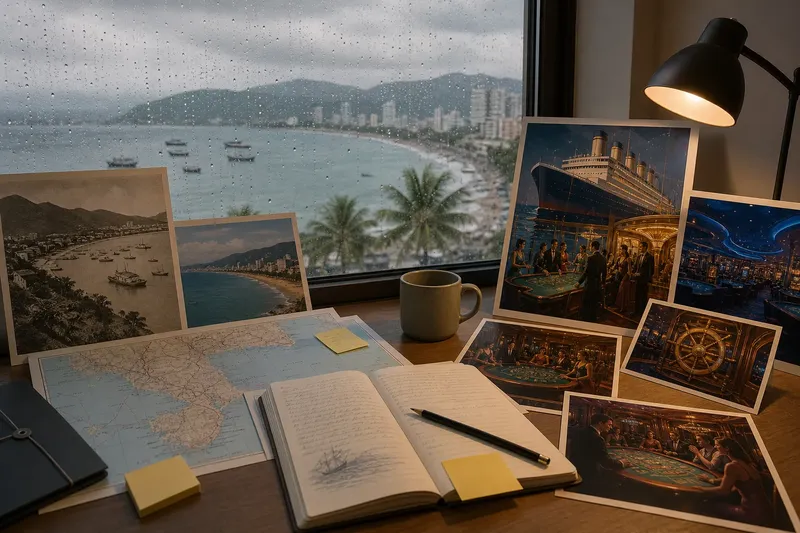
The common mistake on a rainy day in Nha Trang is to treat every image of boats, waves, or ship-shaped interiors as a piece of local maritime history. A Nha Trang waterfront and casino imagery route can instead trace how coastal ideas travel through design: from a harbor view to a hotel lobby, a travel poster, or a film set. That shift makes the subject not whether two images prove a historical connection, but how the sea becomes a visual language for leisure.
Set up with a library catalog, a book, or an online collection you can identify. This is a viewing route through public images and designed spaces, not a claim about which venues or collections are open. Keep the focus on how Nha Trang’s coastal setting is presented alongside casino culture, and on the choices that make those settings feel inviting, dramatic, or distant.
How can you arrange a Nha Trang imagery route?
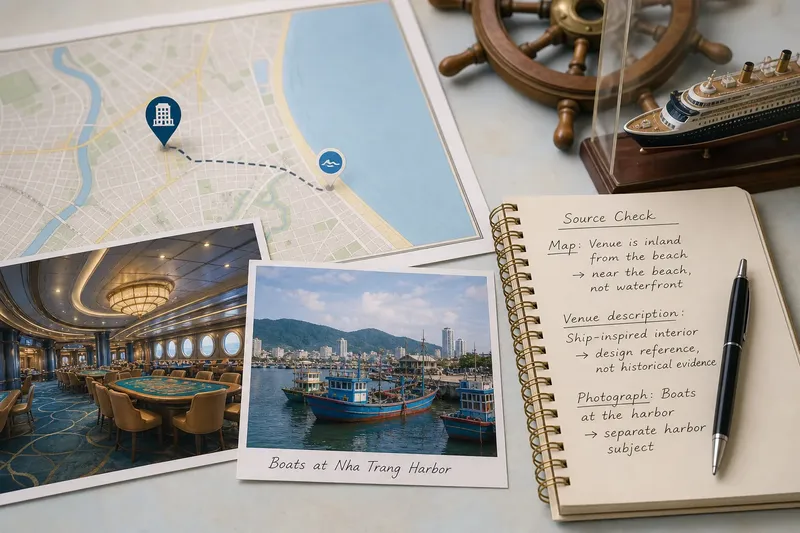
Use a table or desk as a small viewing station. Put maps and waterfront images on one side, casino-related material on the other, and a notebook between them. Rather than trying to join the sources into a single history, follow recurring design choices: a blue palette, a horizon line, a ship silhouette, or a view that makes an interior seem open to the coast.
Gather a pencil, sticky notes, and a folder or document for source details. For online material, save the collection name and caption beside your notes. The caption can clarify whether you are looking at a map, photograph, advertisement, or scene from a work of fiction; without that context, visual comparison can become guesswork.
- Place named: If the title, caption, or map identifies Nha Trang, use it as local material; if it names another place or only a broad region, mark it as comparison and do not assign it to Nha Trang.
- Image type: If a catalog identifies a photograph, illustration, film still, or advertisement, interpret it in that form; if the medium is unclear, describe what is visible and avoid claims about its production or use.
- Date supplied: If a source gives a date or date range, record it as stated; if it is undated, leave the date open rather than estimating it from style.
- Caption detail: If the caption names a person, event, or activity, attribute that claim to the caption; if it does not, avoid identifying those details from appearance alone.
- Design motif: If waves, anchors, or ship shapes recur across items, record the motif as a visual choice; if you want to claim a historical relationship, seek a source that directly addresses it.
- Audience or purpose: If a source says it guides, advertises, documents, or entertains, note that stated purpose; if the purpose is unknown, do not turn an impression into a fact.
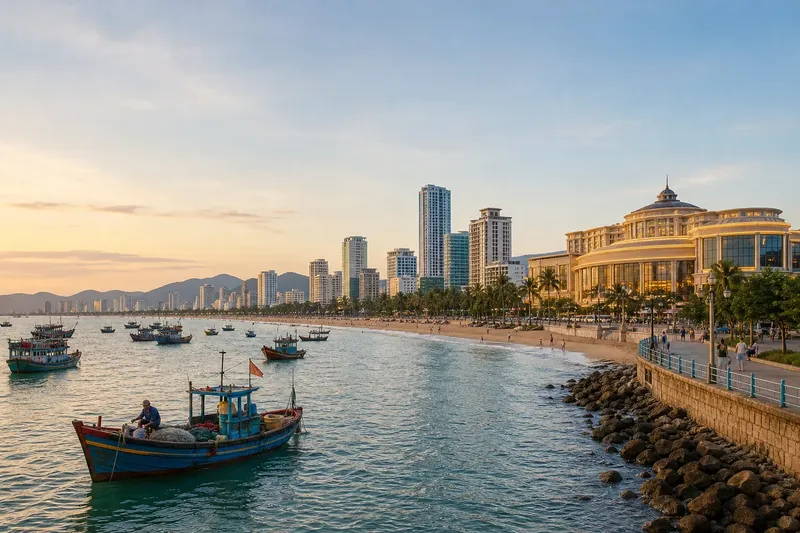
On the waterfront side, notice how a frame makes the coast legible: which places are named, where the horizon sits, and whether people or boats appear. On the casino side, look at how lighting, room layout, and signs direct attention. These sources may share design cues without sharing an origin or a documented history.
What design choices make the coast feel present?
Begin with the elements a viewer can actually see: color, framing, line, light, and scale. A travel image might give the sea a broad, open horizon, while an interior might use blue lighting or a ship-shaped ornament to suggest a maritime mood. Describe the choice before deciding what it means.
Maps offer a different kind of coastal image. Read the title, legend, date, and stated purpose before following a line or symbol. A tourist map, regional map, and navigational chart each arrange information for a different use; a line on a map does not by itself document a particular voyage.
For a Nha Trang-focused reading, check that the map identifies the city or clearly covers the relevant coast. A map of another Vietnamese port can help you notice differences in labeling or visual emphasis, but it remains comparison material, not evidence about Nha Trang itself.
How does a waterfront photograph shape the view?
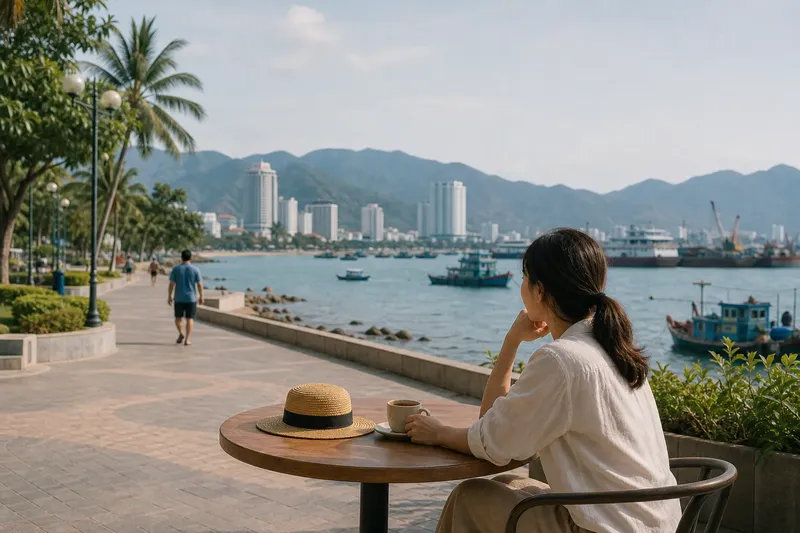
Look at the frame before interpreting it: shoreline, boats, buildings, people, open water, and any visible activity. “Boats appear near the shore” is a description. Naming their cargo, owners, or purpose requires information beyond the visible scene.
Captions and catalog records can help identify a photograph, though they may be incomplete. Preserve uncertainty if a description gives only a broad location or no date. A picture labeled “Nha Trang” may show part of the coast without identifying a particular activity or event.
Also notice what the frame leaves out. A scenic view can exclude nearby activity; a close view of boats can hide the wider waterfront. The photograph is useful for asking how the coast is presented, while its boundaries limit what it can tell you.
How do casinos borrow the language of the sea?
First identify the source. A photograph, promotional illustration, film scene, and passage in a novel each represent casino culture differently. A film still may arrange a room for drama; it is not automatically a record of a real venue’s appearance or operation.
Then look at tables, signs, clothing, lighting, and the viewpoint offered to the audience. Does the image present the casino as a social room, a spectacle, or a setting for a story? Its emphasis tells you how that particular source constructs leisure, not how every visitor experienced it.
Waves, anchors, ship-like decoration, and nautical colors can make the sea part of a casino’s visual vocabulary. Their presence does not, on its own, document a link to Nha Trang’s working waterfront or a historical sea route. To explore an actual relationship, look for an attributable venue history, local account, or other source that discusses it directly.
How can you compare images without flattening their differences?
Write a separate observation for each source before comparing them. A map organizes places; a photograph frames a view; an advertisement invites an audience; and a film scene stages a mood. Ask what each image is designed to make visible, and what it leaves unsaid.
- Source type: If the catalog identifies the item as a map, photograph, film still, or advertisement, interpret it within that form; if the type is unclear, restrict your note to visible details and leave its purpose open.
- Setting: If a caption or image identifies Nha Trang, record that place; if the location is uncertain, mark it as unresolved and do not assign a local setting.
- Visible detail: If a feature is plainly visible, describe it directly; if your note interprets it, mark that interpretation as an inference or question.
- Intended use: If a source states that it documents, guides, advertises, or entertains, record that purpose; if no purpose is stated, distinguish your impression from a documented fact.
- Recurring motif: If nautical imagery appears in multiple sources, compare its form and placement; if you cannot establish a shared history, keep the comparison about design.
- Next question: If your question concerns a date, policy, or actual use, seek a source that addresses that point; if none is available, leave the question open rather than filling the gap with an inference.
Say Mina has a regional map, a waterfront photograph captioned only “Nha Trang,” and a film still showing a casino interior with ship-like decoration. She checks the map’s legend and writes down its named coastal places, but does not assign a journey to them. She describes the photograph’s shoreline and boats, leaving their purpose unspecified. She identifies the last item as a film still and notes the ship-like decoration as part of its set design. The resulting comparison is clear: all three sources use or organize coastal imagery, but the materials do not establish a historical link between Nha Trang’s waterfront and the casino scene.
Which questions help you read waterfront and casino imagery?
Can a map show that a particular ship traveled a route?
Only if the map or an accompanying record identifies an actual journey. A chart may show navigational features or possible connections without documenting a vessel’s passage.
Can a casino film scene explain how a real venue operated?
It can show how that production represented a casino or casino culture. For details about an actual venue, look for a source that addresses it directly.
What should you do with an undated waterfront photograph?
Record it as undated if that is all the source provides. Describe visible features, but do not assign a period based only on clothing, buildings, or visual style.
How can you compare sources when you have only a few?
Compare their settings, purposes, visible details, and limits rather than trying to build a complete history from a small selection. Keep each claim proportional to what those sources support.
What belongs on your comparison page?
Write one note about the coast, one about the casino image, and one about the visual relationship between them. You might record that a map names coastal places, a photograph frames part of the Nha Trang waterfront, and a film still uses ship imagery in a casino scene. If the sources do not connect the harbor to the depicted venue, say so plainly.
A Nha Trang waterfront and casino imagery route is most useful when it lets a real coastal setting and an imagined leisure setting remain distinct. Keep the source details beside each observation, especially when an image is undated or its location is uncertain. If you want to move from visual resemblance to local history, look for a source that explains how a specific image, venue, or design choice came to be.